China produces the majority of the world's educational robots, and the quality has never been better. From $120 coding kits to $1,800 humanoid platforms, Chinese manufacturers offer solutions for every grade level and budget. This guide helps educators and parents choose the right robot for their students.
Choosing by Age Group
The most important factor in selecting an educational robot is matching it to the student's age and skill level.
Ages 6-10: Introduction to Coding
At this stage, students need visual, block-based programming with immediate physical feedback.
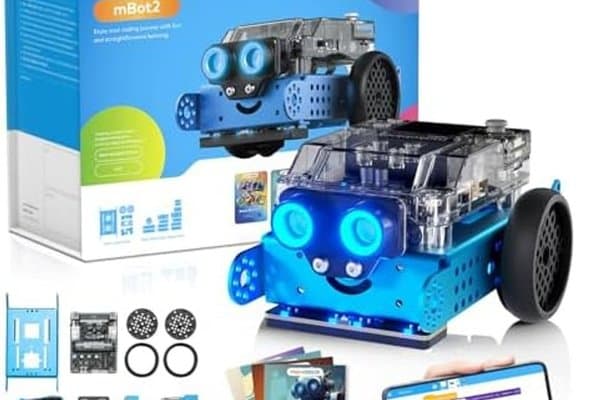
Best choice: Makeblock mBot2 ($150 - $200)
The mBot2 uses mBlock (Scratch-based) programming, has built-in sensors, and comes with structured lesson plans. It's the world's most popular classroom coding robot for a reason — it just works.
Ages 10-14: Intermediate Programming
Students are ready for text-based programming (Python) and more complex robot behaviors.
Best choice: DJI RoboMaster S1 ($500 - $700)
The RoboMaster S1 is the most engaging robot for this age group. Its tank-like design with gel blaster makes programming feel like building a video game character. Students progress from Scratch to Python while learning AI concepts like visual recognition and path planning.
Ages 14-18: Advanced Robotics
High school students benefit from industry-relevant platforms that teach real-world skills.
Best choice: Elephant Robotics myCobot 280 ($500 - $800)
The myCobot is a real 6-axis robotic arm that teaches the same concepts used in industrial automation. Supporting ROS, Python, and C++, it bridges educational robotics and professional development.
University Level: Research Platforms
University programs need platforms that support cutting-edge research.
Best choice: UBTech Yanshee ($1,200 - $1,800)
The Yanshee humanoid robot teaches AI, computer vision, and IoT with a full ROS2 SDK. Its humanoid form factor engages students more than wheeled platforms.
Price Comparison for Classroom Sets
| Robot | Unit Price | Set of 15 (est.) | Best For |
|---|---|---|---|
| Hiwonder TurboPi | $120 - $180 | $1,500 - $2,300 | Maker spaces, DIY |
| Makeblock mBot2 | $150 - $200 | $1,900 - $2,500 | Elementary/Middle school |
| DJI RoboMaster S1 | $500 - $700 | $6,500 - $9,000 | Middle/High school |
| myCobot 280 | $500 - $800 | $6,500 - $10,000 | Technical college |
| UBTech Yanshee | $1,200 - $1,800 | $15,000 - $23,000 | University AI programs |
Most manufacturers offer 15-30% education discounts for verified schools. Contact us for volume pricing.
What Makes Chinese Educational Robots Different
1. Price Advantage
Chinese educational robots cost 20-40% less than Western alternatives like LEGO Mindstorms or VEX Robotics, while offering comparable or superior features.
2. Modern Technology
Chinese manufacturers integrate the latest technology — AI vision, voice recognition, IoT connectivity — into educational robots faster than Western brands.
3. Global Curriculum Support
Top brands like Makeblock and DJI provide full English curriculum aligned with international STEM standards (NGSS, ISTE). Teacher training resources are comprehensive.
4. Competition Ecosystem
DJI runs the global RoboMaster competition, Makeblock organizes MakeX events, and UBTech hosts AI robot competitions. These give students real-world goals to work toward.
5 Tips for Buying Classroom Robots
- Request a trial unit — test with actual students before committing to a class set
- Verify curriculum alignment — ensure the robot's programming environment matches your curriculum goals
- Check teacher training — the best robot is useless without trained educators. Prioritize brands with strong training programs
- Plan for maintenance — budget for spare parts and replacement units (10-15% of fleet value annually)
- Start simple, scale up — it's better to master a $150 mBot before moving to a $700 RoboMaster
Getting Started
Whether you're equipping a single classroom or an entire school district, Chinese educational robot manufacturers offer the best combination of quality, features, and value in 2026.