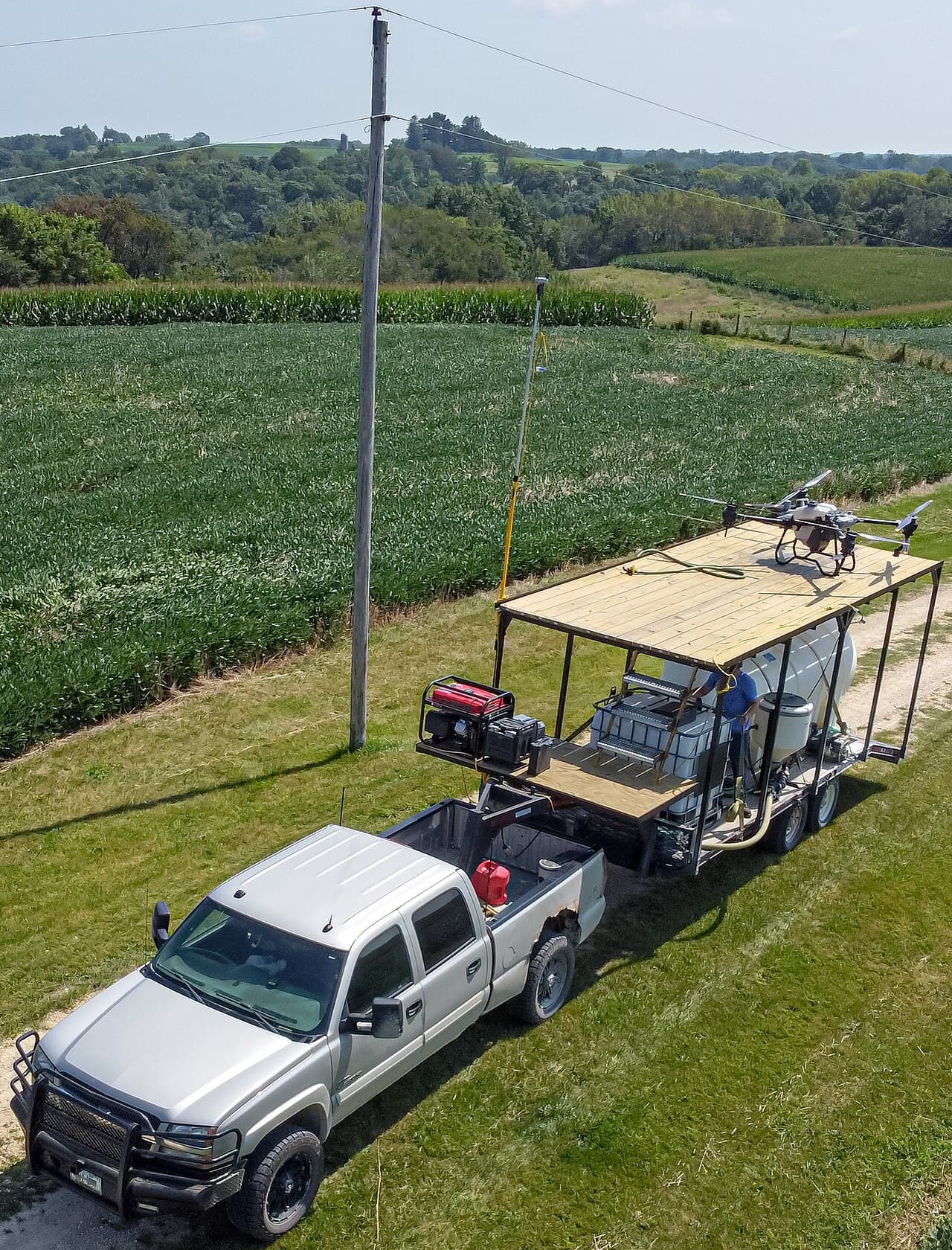
As farmers across multiple regions prepare for what meteorologists are forecasting as a notably dry 2026 harvest season, agricultural drone operators are playing an increasingly central role in crop management. Drone pilots are being contracted to apply crop protection products, seed treatments, and fertilizers across terrain where conventional ground equipment — tractors and sprayers — either cannot operate safely or cannot reach without causing soil compaction and crop damage.
Reaching Where Tractors Cannot Go
The practical value of agricultural drones in difficult terrain conditions is well established in Asia, where steep hillside rice paddies, fragmented field sizes, and water-intensive crops made aerial spraying an early priority. That operational logic is now translating directly to North American and European farming contexts where drought-cracked soils, wet field edges, and hilly topography create similar access challenges.
Drone-based applications offer several agronomic advantages beyond access. Targeted precision application reduces the volume of crop protection products required per hectare, lowering input costs and reducing environmental runoff. High-resolution multispectral imaging — a capability offered by most commercial agricultural drone platforms — enables variable-rate application that matches input levels to plant health data collected from the same drone pass.
Hylio, a Houston-based agricultural drone manufacturer, has expanded its platform to serve applications beyond traditional row-crop spraying, including reforestation seeding, mosquito control, and infrastructure inspection. This market diversification strategy reflects a broader trend among agricultural drone vendors: the core autonomous flight and precision application technology is generalist, and the addressable market extends well beyond the farm gate.
Market Size and Growth Trajectory
The global agricultural robots and drones market was valued at $7.43 billion in 2025 and is projected by Precedence Research to reach $24.26 billion by 2034, representing a compound annual growth rate of approximately 14%. That trajectory reflects simultaneous growth pressures from the farmer side — labor scarcity, input cost management, climate volatility — and from the technology side, where drone flight times, payload capacities, and AI-driven application systems continue to improve on annual cycles.
Regulatory environments are also becoming more accommodating in major agricultural economies. The U.S. FAA's BVLOS (beyond visual line of sight) rulemaking, the EU's UAS regulation framework, and Japan's established precedent for licensed agricultural drone operation are collectively reducing the compliance friction that previously slowed commercial adoption.
The Dry Season Opportunity
For the 2026 season specifically, the dry forecast creates a window where drone operators can demonstrate value that ground equipment simply cannot replicate. When fields are too dry and cracked for heavy equipment without risking machinery damage or causing deep soil disturbance, drones operating at 5–10 meters altitude become the only practical option for in-season crop protection applications. Early-season relationships between drone operators and farmers during stress conditions tend to generate multi-season service agreements, accelerating the commercial adoption curve.
What This Means for Robot Buyers
For farming operations and agricultural service businesses evaluating automation investments, agricultural drones represent one of the highest-ROI robotics categories available today, with payback periods often measured in seasons rather than years. Buyers should evaluate platforms based on tank capacity, battery endurance, autonomy software, and regulatory compliance documentation for their operating jurisdiction. Sourcing through buy from China channels gives access to platforms from DJI Agriculture, XAG, and Hylio's Chinese-manufactured competitors, often at significantly lower per-unit prices than domestically manufactured equivalents.