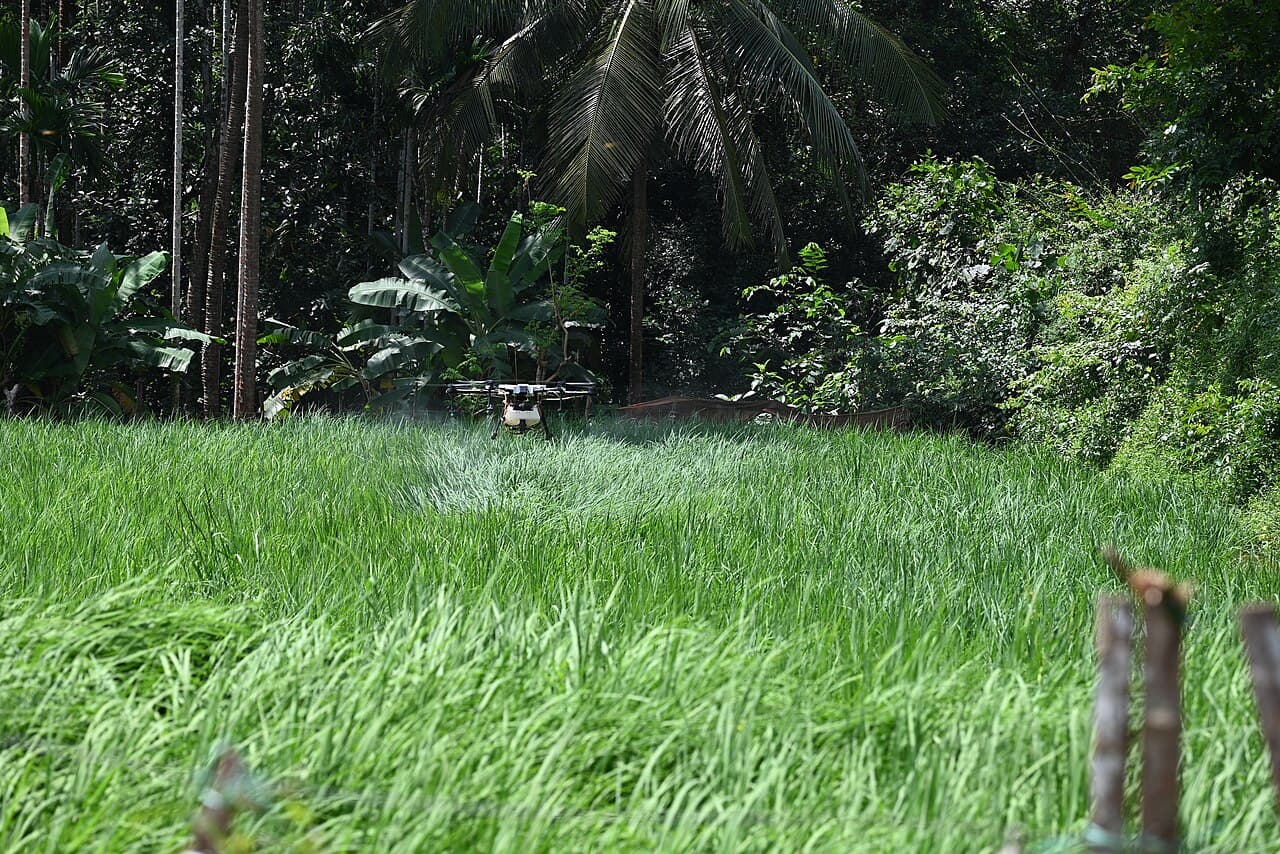
The agricultural drone market is experiencing explosive growth, with current valuations ranging from $3.4 billion to $5.8 billion in 2025 and projections reaching $12 billion to $23 billion by the early 2030s. Depending on the research firm, compound annual growth rates fall between 20% and 26%, making agricultural drones one of the fastest-growing segments in the entire robotics industry.
Hardware Advances Push Capabilities Forward
DJI's new Agras T100 represents the current state of the art in agricultural spraying drones. Equipped with a 100-liter tank, the T100 can cover significantly more acreage per flight than previous generations, reducing the number of battery swaps and refills needed per session. Its precision nozzle system and RTK GPS positioning enable variable-rate application, delivering exact amounts of pesticide, herbicide, or fertilizer based on prescription maps.
But the bigger story may be swarm technology. Hylio has become the first company to receive FAA approval for a single-operator, three-drone swarm operation. This means one trained pilot can manage three spraying drones simultaneously, tripling throughput without tripling labor costs. The regulatory approval is a landmark moment that opens the door for larger swarm operations in the future.
Regulatory Tailwinds
The FAA's Part 108 rules for beyond-visual-line-of-sight (BVLOS) operations are expanding the practical envelope for agricultural drones. Previously, regulations required a visual observer for each drone, severely limiting operational efficiency. Under the evolving framework, approved operators can fly drones over larger areas with fewer personnel, making large-scale agricultural drone services economically viable.
These regulatory changes are not limited to the United States. Brazil, India, Japan, and Australia have all implemented or updated drone-friendly agricultural regulations in the past year, recognizing the technology's potential to address food security challenges.
Drone Delivery Carves Out Market Share
While spraying and crop monitoring dominate, drone delivery has quietly captured approximately 7% of the overall drone market. Agricultural applications are part of this trend, with drones delivering seeds, biological pest control agents, and soil amendments to hard-to-reach areas of large farms. The logistics infrastructure built for drone delivery is also being repurposed for rural agricultural supply chains.
Precision Farming Integration
Modern agricultural drones do far more than spray. Multispectral and hyperspectral imaging sensors enable early detection of crop stress, disease, and nutrient deficiencies. AI-powered analytics platforms process drone imagery to generate actionable field maps, and these maps feed directly into variable-rate application systems.
This closed-loop workflow, where drones both diagnose problems and deliver treatments, is the core value proposition of precision agriculture. Farms using integrated drone systems report input cost reductions of 15-30% while maintaining or improving yields.
What This Means for Robotics Buyers
For agricultural operations evaluating drone technology, the market has matured considerably. Buyers looking at agricultural drones will find reliable platforms from DJI, Hylio, XAG, and others, with proven ROI in spraying, mapping, and monitoring applications.
The economics are compelling. A commercial agricultural drone system that costs $15,000 to $30,000 can pay for itself within one or two growing seasons through reduced chemical usage and labor savings. RaaS models are also available for operations that prefer not to own equipment.
Buyers should also consider industrial drones for adjacent applications like infrastructure inspection, livestock monitoring, and boundary surveying. The same platforms and skills often transfer across use cases, maximizing the return on investment in drone technology and pilot training.